Methods blog · AI-empowered Assistive Technology for Disability Research
Oriental BrailleFirst prize at the AI Hackathon for People with Disabilities
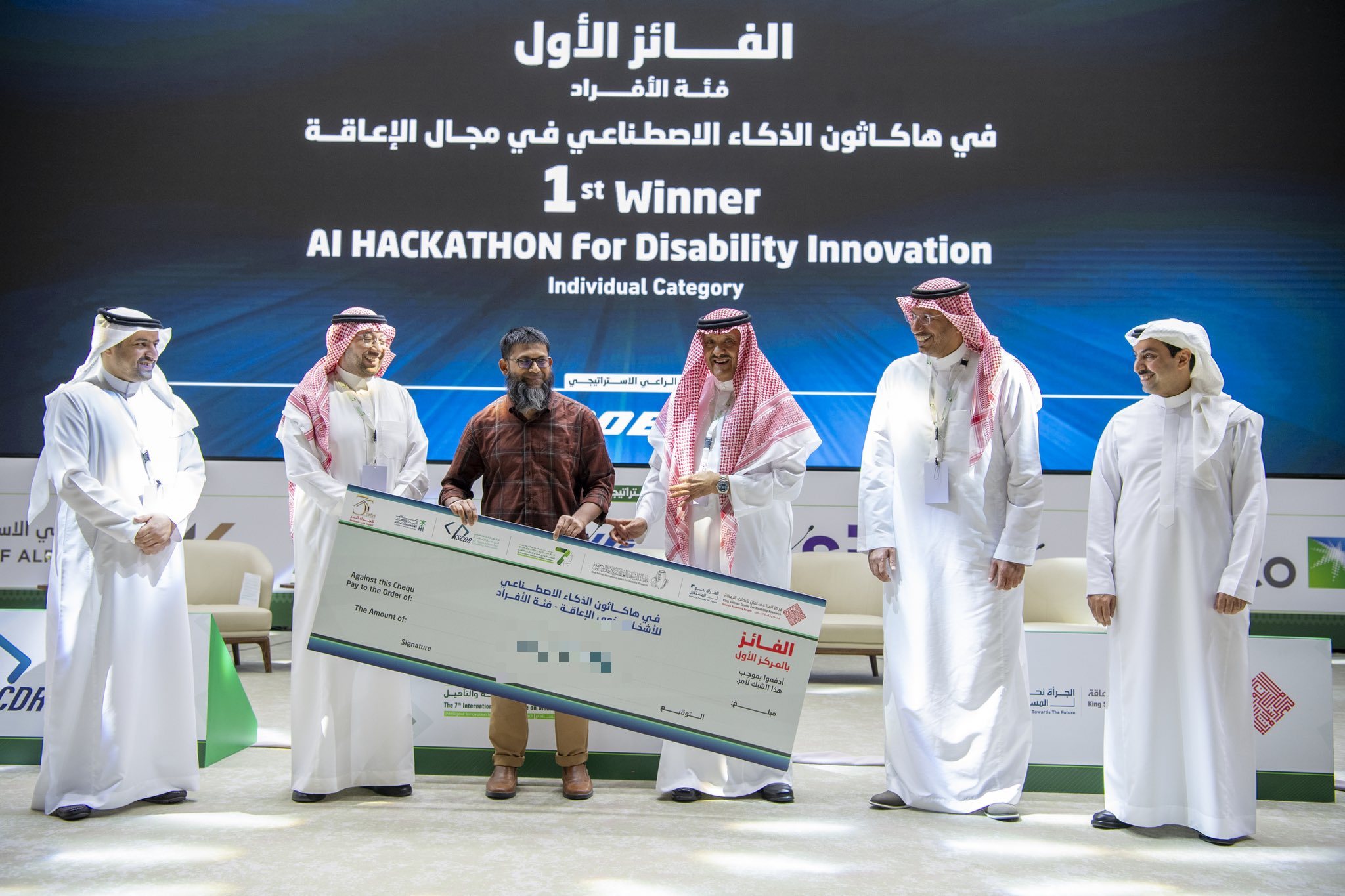
The Oriental Braille Project, led by Dr AKM Azad, won first place (Individuals track) at the AI Hackathon for People with Disabilities, held alongside the 7th International Conference on Disability and Rehabilitation and organised by the King Salman Center for Disability Research.
#news#award#hackathon#accessibility#braille#3D printing
We are delighted to share that The Oriental Braille Project won first place in the Individuals track of the AI Hackathon for People with Disabilities. The hackathon was held alongside the 7th International Conference on Disability and Rehabilitation and organised by the King Salman Center for Disability Research (KSCDR).
The team
- Dr AKM Azad (team lead), College of Science, IMSIU
- Mohammed Hussain
- Yaqoub Ali
The project was supported by IMSIU’s Deanship of Scientific Research.
The project: Oriental Braille
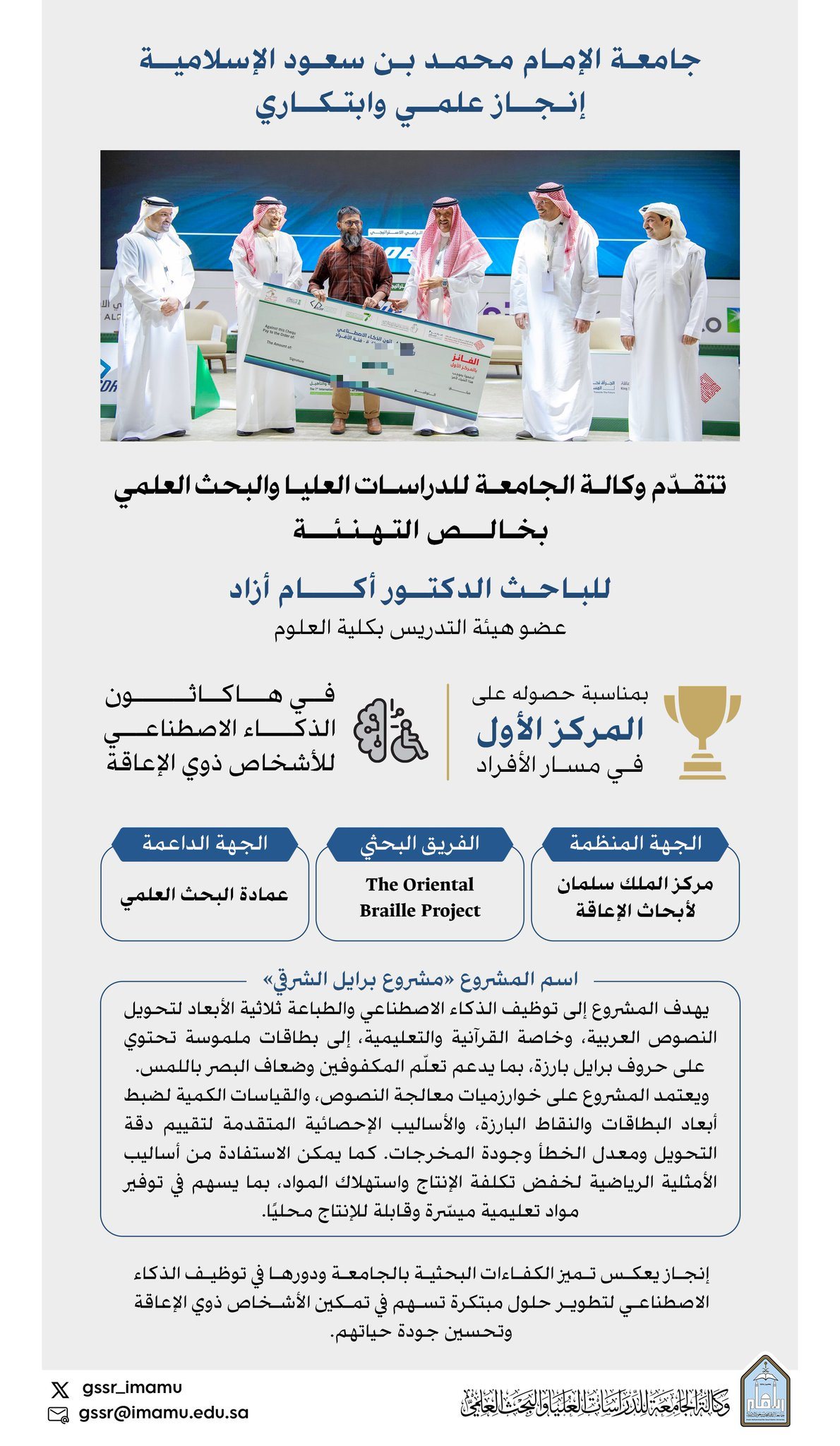
Blind and visually impaired learners in the Arabic-speaking world have limited access to affordable tactile reading material, especially for Quranic and educational texts. The Oriental Braille Project (مشروع برايل الشرقي) uses artificial intelligence and 3D printing to convert Arabic text into tactile cards with raised Braille, so that readers can learn by touch.
The pipeline combines several parts of the lab’s toolkit:
- Text processing. Algorithms prepare Arabic text, including Quranic and educational passages, for conversion into Braille.
- Quantitative calibration. Measurements set the dimensions of the cards and the raised dots so that the printed Braille is legible to touch.
- Statistical quality control. Statistical methods assess conversion accuracy, error rate and the quality of the printed output.
- Mathematical optimisation. Optimisation reduces production cost and material use, so the cards can be produced affordably and locally.
The goal is accessible, low-cost educational material that empowers people with visual disabilities and improves their quality of life. It continues the lab’s work with the King Salman Center for Disability Research (see our projects).
Media coverage
The award was covered by the organiser and by the university:
- King Salman Center for Disability Research (@kscdr), 13 October 2026: announcement of the first-place winner of the Individuals track, naming the team (in Arabic). View the post on X
- IMSIU Vice-Rectorate for Graduate Studies and Scientific Research (@GSSR_ImamU), 14 October 2026: congratulations to Dr AKM Azad, with an infographic describing the project (in Arabic). View the post on X
- Imam Mohammad Ibn Saud Islamic University (@IMSIU_EDU_EN), 14 October 2026: “A research team from the College of Science at #IMSIU wins first place in the Individuals category of the AI Hackathon for People with Disabilities…” View the post on X
- IMSIU news: IMSIU Research Team Wins First Place in AI Hackathon for People with Disabilities. Read the article on imamu.edu.sa
Congratulations to the whole team, and thank you to KSCDR, the conference organisers and the IMSIU Deanship of Scientific Research for their support.